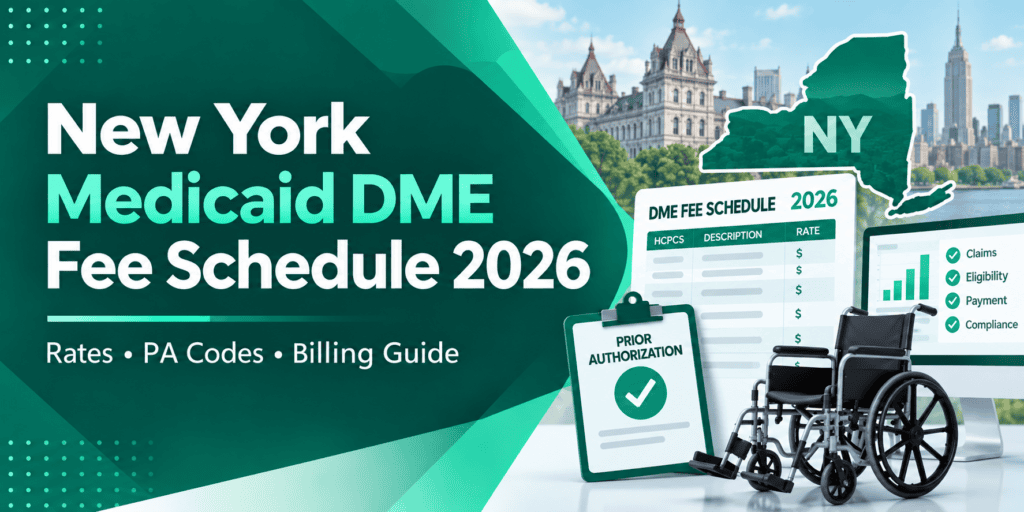
New York’s Medicaid DME fee schedule looks simple until a biller reaches the columns after the HCPCS description.
A rate may be present, but the same row can also carry a rental amount, a maximum monthly quantity, a By Report indicator, or a numbered authorization code. Those fields are not administrative decoration. They help determine how the item should be priced, approved and billed.
For 2026, the current NYS Medicaid DMEPOS schedule supplied for this guide is effective July 1, 2026. It should be used together with the current eMedNY DME policy manual, procedure-code manual and provider communications rather than as a stand-alone price list.
New York Medicaid DME Fee Schedule 2026 at a Glance
Analysis of the July 2026 workbook supplied for this page shows:
| Schedule detail | July 2026 workbook |
|---|---|
| Populated schedule rows | 1,763 |
| Unique HCPCS/code values | 1,752 |
| Rows with a numeric fee | 1,617 |
| Rows with a numeric rental fee | 76 |
| Rows marked BR or BR SC | 20 |
| Rows carrying a PA code | 1,516 |
| Rows marked Pharmacy Only | 27 |
Rows marked with * in CHANGE | 54 |
| Median numeric fee | $102.01 |
| Highest numeric fee in the workbook | $23,145.25 |
The PA field is particularly important. In this workbook, PA 6 is by far the most common authorization code, followed by PA 1 and PA 4. That matters because PA 6 is not the same process as a traditional clinical prior approval.
New York Medicaid DMEPOS Fee Schedule Table
New York Medicaid DMEPOS fee schedule
Search any HCPCS code across the whole schedule, and see at a glance what it pays, how many units a month you can bill, and which prior approval route applies.
No codes match. Try the HCPCS code on its own, or clear the filters above.
What the columns and prior approval codes meanShowHide
The maximum reimbursable Medicaid fee. Where no fee is listed, the item is priced during the prior approval process.
The fee on file for DME items that may be rented without prior approval.
For medical and surgical supplies, the maximum allowed per month. If the fiscal order exceeds this amount, the provider must obtain prior approval.
Payment depends on obtaining Department of Health approval before the service is provided. Without that approval no reimbursement is made. The number in the source schedule records which method applies.
PA code 6. Electronic prior approval through the Medicaid Eligibility Verification System Dispensing Validation System.
PA code 1. Prior approval using eMedNY form 361501.
PA code 4. Automated voice interactive telephone prior authorization. The prescriber writes the authorisation number on the fiscal order and the dispenser completes the process by phone.
Reimbursement is determined from a report. Documentation covering the nature, extent and need for the item, plus time, skill and equipment, must accompany the claim.
For speciality enterals and prescription footwear, by-report rules apply when the charge is greater than the listed screen price.
The item is marked pharmacy only in the source schedule.
An asterisk in the source schedule marks a code that changed since the last posting.
Source: New York State Department of Health, NYS Medicaid DMEPOS Services Fee Schedule, effective July 1, 2026. Column definitions follow the eMedNY Fee Schedule Column Descriptions. Descriptions are truncated in the source schedule. Fees are maximums for fee-for-service and may differ from managed care plan rates. Confirm current rates with eMedNY before billing.
For the published page, the table should be searchable by HCPCS code and description and filterable by PA type, rental fee, BR/BR SC, maximum units, Pharmacy Only and CHANGE status.
A useful table note would be:
Rates shown are New York Medicaid Fee-for-Service schedule amounts effective July 1, 2026. Coverage, authorization, member eligibility, third-party liability and documentation requirements still apply. Managed care reimbursement may differ.
How to Read the New York Medicaid DME Fee Schedule
Code and Description
The CODE column identifies the HCPCS or other reimbursable procedure code. The description is abbreviated, so billers should use the current eMedNY DME procedure-code manual when the shortened spreadsheet wording does not fully explain the item.
A code appearing on the spreadsheet confirms that the schedule contains a reimbursement pathway for that line; it does not by itself establish that every member, quantity or billing situation is payable.
Fee
The FEE column is the maximum Medicaid fee on file for that schedule row.
For DME purchases, New York policy generally limits reimbursement to the lower of the Medicaid fee schedule amount or the provider’s usual and customary charge to the public.
This matters when a provider’s normal selling price is below the state amount. The fee schedule is a ceiling, not a reason to bill above the provider’s usual and customary price.
Rental Fee
The RENTAL FEE column identifies a rental amount on file for equipment that can be rented under the applicable rules.
New York’s policy manual also provides a broader rental methodology: where a DME item has a Maximum Reimbursement Amount, the monthly rental is generally 10% of that amount; where no MRA exists, rental is generally calculated at 10% of the provider’s acquisition cost. Accumulated rental payments cannot exceed the actual purchase price.
The fiscal order matters here. When the ordering practitioner specifies a need of less than 10 months, equipment that can be rented must initially be rented. For a stated need of 10 months or more, the equipment may initially be rented or purchased.
BR — By Report
BR means the payment must be determined By Report rather than by simply taking a fixed amount from the table.
The provider may need to submit information showing the nature and need for the item or service, along with supporting documentation such as an invoice or detailed description.
Some rows in the July 2026 workbook have no fixed fee and carry BR. A blank fee in that context should not automatically be interpreted as “not covered.”
BR SC — Screen Price
BR SC is especially important for specialty enteral formulas and certain other lines.
A screen price works as a threshold rather than an unconditional maximum reimbursement amount. For specialized enteral formula, if the amount charged exceeds the listed screen price, an invoice is required and the claim is manually reviewed. Current New York policy states that qualifying claims are priced at acquisition cost plus 31%.
In the July schedule supplied for this guide, examples of BR SC enteral rows include B4154, B4155, B4157, B4161 and B4162.
Maximum Units
For medical and surgical supplies, MAX UNITS generally identifies the maximum quantity allowed per month.
If a member needs more than the listed limit, the provider should not simply increase the quantity on the claim. New York requires prior approval with medical documentation supporting why the usual maximum is insufficient.
This column is particularly important for recurring items such as incontinence supplies, enteral products, catheters and other consumables.
Prior Authorization (PA)
New York’s PA column is easy to misread because the number does not represent a quantity. It identifies an authorization method.
| PA code | What it means operationally |
|---|---|
| 1 | Formal prior approval is required |
| 4 | Automated authorization used for the applicable enteral process |
| 6 | Electronic authorization through MEVS Dispensing Validation System (DVS) |
| 9 | Automated telephone prior authorization through VIPS under the fee-schedule legend |
The July 2026 workbook contains PA 1, PA 4 and PA 6 rows. The official eMedNY fee-schedule legend also defines PA 9.
The distinction is critical. A PA 6 item is handled through DVS, not through the same review route as a PA 1 item.
Change Indicator
An asterisk in the CHANGE column tells the provider that something about the code changed since the previous posted schedule.
The July 2026 file contains 54 rows with this marker. Instead of assuming the asterisk means “new rate,” billers should compare the current procedure-code guidance because the change can relate to coding, description, units, coverage or another schedule element.
Common New York Medicaid DME Rates in the July 2026 Schedule
The full table should remain the main lookup tool, but the following examples give billers a sense of how purchase, rental and authorization information appears.
| HCPCS | Item | Fee | Rental fee | Max units | PA |
|---|---|---|---|---|---|
| A4253 | Blood glucose test strips, per 50 | $20.00 | — | 4 | 1 |
| E0601 | CPAP device | $501.16 | $50.12 | 1 | 6 |
| E1390 | Oxygen concentrator | $138.65 | $138.65 | 1 | 6 |
| E0431 | Portable gaseous oxygen system | $30.72 | $30.72 | 1 | 6 |
| E0466 | Home ventilator, non-invasive | $738.31 | $738.31 | 1 | 6 |
| E0570 | Nebulizer compressor | $119.07 | — | 1 | 6 |
| E0143 | Folding wheeled walker | $93.13 | — | 1 | 6 |
| E0163 | Commode chair | $104.67 | — | 1 | 6 |
| K0001 | Standard wheelchair | $283.19 | $28.32 | 1 | 6 |
| K0003 | Lightweight wheelchair | $565.10 | $56.51 | 1 | 6 |
| K0823 | Group 2 standard power wheelchair | $4,063.94 | — | 1 | 1 |
| A7030 | Full-face PAP mask | $144.64 | — | 1 | 6 |
The examples also show why one pricing rule cannot be applied to every rental row. Some HCPCS descriptions are inherently rental-based, so the FEE and RENTAL FEE can be the same. Other items show a purchase amount with a separate monthly rental amount.
Why the Listed Fee Is Not Always the Final Payment
For purchases with a fixed New York Medicaid fee, reimbursement generally cannot exceed the lower of the schedule amount or the provider’s usual and customary charge.
New York also states that reimbursement includes delivery, setup, necessary fittings and adjustments. Separate charges for ordinary shipping, handling, delivery or fitting are not added on top of the DME fee.
When there is no fee on file, the current policy manual notes that pricing reflects cost plus 51%, although the underlying regulatory wording still states cost plus 50%. For a biller, this is a good example of why current eMedNY policy guidance should be checked before manually pricing an unlisted or no-fee line.
PA 6 and the Dispensing Validation System (DVS)
A large share of the July 2026 DME schedule carries PA code 6.
PA 6 refers to the Dispensing Validation System (DVS), an electronic approval process completed through the Medicaid Eligibility Verification System.
For selected medical supplies, DVS provides a five-day period of service. For DME, orthotics, prosthetics and orthopedic footwear, the approval period is 180 days.
The DVS number should be obtained on the date required by program rules, and billers should confirm authorization status before the item is dispensed. If there is no claim activity, DVS authorizations can inactivate after 90 days, subject to the third-party payer exception described by eMedNY.
This distinction is one of the most useful New York-specific details to place beside the fee table. Treating every PA indicator as the same workflow can delay delivery or produce an avoidable denial.
New York Medicaid DME Changes Billers Should Know in 2026
Incontinence Product Limits Changed July 1, 2026
New York revised its incontinence-product limits and coverage rules effective July 1, 2026 for Fee-for-Service Medicaid.
One of the clearest changes is HCPCS A4554, disposable underpads. The maximum quantity dropped from 300 to 150.
New York also no longer allows reusable and disposable versions of the same product type during the same 30-day period. The state established revised limits for disposable briefs/liners and reusable products, and claims above the normal allowance require prior approval supported by clinical documentation.
For a billing office, this means a saved 2025 quantity template can create denials even when the HCPCS code itself remains active.
Enteral Authorization Limits Increased in February 2026
Effective February 11, 2026, New York increased automated enteral authorization limits.
For oral-fed members, the portal/IVR limit rose from 1,000 to 1,250 calories per day, with the associated maximum increasing from 300 to 375 caloric units per month.
For tube-fed members, the limit rose from 2,000 to 2,500 calories per day, and from 600 to 750 caloric units per month.
There is an important billing nuance here: some B-code rows in the July fee schedule may still show a MAX UNITS value of 600. The enteral provider communication governs the updated automated authorization allowance, so the static fee table should not be read in isolation when an enteral case approaches the displayed limit.
Backup Power Wheelchair Repairs Received a Dedicated Billing Path
New York issued specific 2026 guidance for repairs to qualifying backup power wheelchairs.
For eligible Group 2 through Group 6 backup PWCs, repairs are direct-billed and do not require prior approval. Providers use K0899 with modifier TW.
The repair benefit is limited to $5,000 over five years. Parts with an established MRA are paid at that amount; parts without an MRA are paid using cost-plus-51% methodology with invoices. Skilled labor uses K0739, currently $18.18 per 15-minute unit, with up to eight units available unless additional labor is supported.
Because missing fields or invoices can cause denial, this is a good case for a code-specific billing checklist rather than relying on the general K0899 schedule row.
Prior-Approval Change Requests Changed September 1, 2026
New York revised its Fee-for-Service prior-approval change process effective September 1, 2026 as part of CMS interoperability implementation.
Only limited changes can be made to an existing approved or adjudicated PA. For changes outside the allowed circumstances, a new prior-approval request is required.
DME offices that routinely “fix” an approved authorization after equipment configuration changes should review this update carefully before modifying HCPCS, quantity or other request details.
Fiscal Order Requirements for New York Medicaid DME
New York’s current DME policy manual requires key information on the fiscal order, including the ordering practitioner, member information, date ordered, signature, item and quantity, directions, refills where applicable, diagnosis and length of need for rental items.
The diagnosis on the fiscal order must match a diagnosis reported on the DMEPOS claim and support medical necessity.
For rental equipment, length of need is not a minor documentation field. It can influence whether the item begins as a rental or may be purchased.
New York Medicaid DME Refill Billing Rules
Automatic refill programs create risk under New York Medicaid.
Before a DMEPOS refill, the supplier must document contact with the member or representative within 30 calendar days of the expected end of the current supply and confirm that the refill is still needed.
New York also prohibits billing a refill before it is furnished, automatic refills, quantities above the fiscal order and supplying the refill more than 10 days before the current product is expected to run out.
That is particularly important for recurring incontinence, diabetic, enteral and wound-care supplies.
DME Billing for Medicare-Medicaid Dual-Eligible Members
For members who have both Medicare and Medicaid, New York treats Medicaid as payer of last resort.
For DMEPOS that normally requires Medicaid prior approval, providers generally must obtain evidence of Medicare approval or denial before requesting Medicaid authorization. When the DME MAC denies the item, the Medicaid request may require documentation showing that the Medicare reconsideration was also denied, subject to the exceptions described in the state policy.
This is a common reason a claim that looks correct from the Medicaid fee-schedule side can still be premature.
Fee-for-Service, Managed Care and Workers’ Compensation Use Different Rules
The table on this page is a New York Medicaid Fee-for-Service DMEPOS schedule.
A Medicaid managed care plan can have its own reimbursement and authorization requirements, so the FFS amount should not automatically be treated as the plan’s contracted payment.
There is also a separate New York Workers’ Compensation DME Fee Schedule. It can appear in searches for “New York DME fee schedule,” but it applies to workers’ compensation claims and has its own rules and prior-authorization process. DME billers should confirm the payer before using any New York rate sheet.
Common New York Medicaid DME Denial Points
| Billing issue | What to check before rebilling |
|---|---|
| Wrong authorization route | Confirm whether the row is PA 1, PA 4, PA 6/DVS or another pathway |
| DVS inactivated | Check authorization status before dispensing and claiming |
| Units exceed schedule limit | Determine whether formal prior approval is needed for the excess quantity |
| BR/BR SC claim lacks support | Attach the required report or invoice based on the pricing method |
| Diagnosis mismatch | Match the fiscal-order diagnosis to a diagnosis reported on the claim |
| Refill supplied too early | Confirm member request, current supply end date and refill timing |
| Item billed before delivery | Use the actual dispensing/delivery date as required |
| Medicare or third party not processed first | Resolve other coverage before billing Medicaid when required |
| Managed care member billed to FFS rules | Route the claim and authorization to the member’s plan |
| Missing proof of delivery | Retain signed or otherwise compliant delivery evidence |
| Site/enrollment problem | Verify the dispensing location and NPI are properly enrolled |
| Old schedule used | Recheck codes marked CHANGE and current eMedNY communications |
New York Medicaid DME Pre-Bill Checklist
At DBS (dmebillingservice), these checks are part of the pre-bill review process used to identify coding, authorization, and documentation issues before claims are submitted.
- Member eligibility on the relevant order and service dates.
- FFS versus Medicaid managed care enrollment.
- Correct enrolled DMEPOS location and NPI.
- Current HCPCS and procedure-code coverage.
- Fee, rental fee and pricing method.
- PA route, formal PA, enteral authorization, DVS or direct bill.
- Maximum units and frequency.
- Fiscal order, diagnosis and length of need.
- Medicare/third-party payment requirements.
- Delivery and refill documentation.
- Any 2026 provider communication affecting the item.
- Exact claim date of service, which for materials and appliances is generally the dispensing or delivery date.
The point is not to create more work. It is to move the checks that most often cause denials to the front of the billing process.
Frequently Asked Questions About the New York Medicaid DME Fee Schedule
What Is the Current New York Medicaid DME Fee Schedule for 2026?
The current DMEPOS schedule used for this guide is effective July 1, 2026. eMedNY also updated the DME policy guidelines, procedure codes and related resources for the July 2026 cycle.
Is the NY Medicaid DME Fee the Guaranteed Payment Amount?
No. The fee is a maximum reimbursement amount on the Fee-for-Service schedule. Payment can also be limited by the provider’s usual and customary charge, member eligibility, authorization, units, third-party liability, documentation and other program rules.
What Does PA 6 Mean on the New York DME Fee Schedule?
PA 6 means electronic authorization through the Medicaid Eligibility Verification System Dispensing Validation System, or DVS. It should not be handled like a PA 1 formal prior-approval request.
What Does PA 4 Mean?
PA 4 identifies the automated authorization route used for the applicable enteral process. The prescriber and dispenser have different steps in that workflow.
What Does BR Mean on the Schedule?
BR means By Report. The payment is determined from supporting information rather than simply from a fixed fee. Documentation can include itemized invoices and information explaining the item or service.
What Does BR SC Mean?
BR SC identifies a screen-price situation. For specialized enteral formulas, an invoice is required when the amount billed exceeds the screen price, and the claim is manually reviewed.
Can a DME Supplier Bill More Than the Maximum Units?
When a member needs more than the standard service limit, New York requires prior approval supported by clinical documentation explaining why the higher quantity is medically necessary.
Why Does a Code Show Both a Fee and a Rental Fee?
Some DME can be purchased or rented depending on the policy and length of need. The rental amount is not necessarily a second payment added to the purchase price; it is the reimbursement pathway when the item is rented.
Can New York Medicaid DME Suppliers Bill Shipping Separately?
Ordinary shipping, handling, delivery, setup, fittings and adjustments are generally included in the Medicaid reimbursement and are not separately payable.
Does This Fee Schedule Apply to Medicaid Managed Care Plans?
It is the New York Medicaid Fee-for-Service schedule. Managed care plans may use different payment arrangements and authorization processes.
Is the New York Workers’ Compensation DME Fee Schedule the Same as Medicaid?
No. The Workers’ Compensation Board maintains a separate DME fee schedule and prior-authorization framework for work-related injury claims. It should not be substituted for the Medicaid FFS DMEPOS schedule.
Final Takeaway for New York DME Suppliers
The July 2026 New York Medicaid DMEPOS schedule becomes much more useful once the columns are read as billing instructions rather than spreadsheet labels.
The fee tells the billing team where pricing starts. RENTAL FEE establishes an alternate reimbursement route for applicable equipment. BR and BR SC signal manual pricing rules. MAX UNITS identifies quantity controls. The PA number tells the supplier which authorization system to use.
For New York DME suppliers handling large volumes of Medicaid claims, combining those fields with current eMedNY policy, 2026 provider communications and a consistent pre-bill review can prevent many of the errors that otherwise surface only after equipment has been delivered.
A specialized New York DME billing service can support eligibility verification, DVS and prior-approval checks, HCPCS coding, rental billing, documentation review, denials and A/R follow-up when those responsibilities become difficult to manage internally.