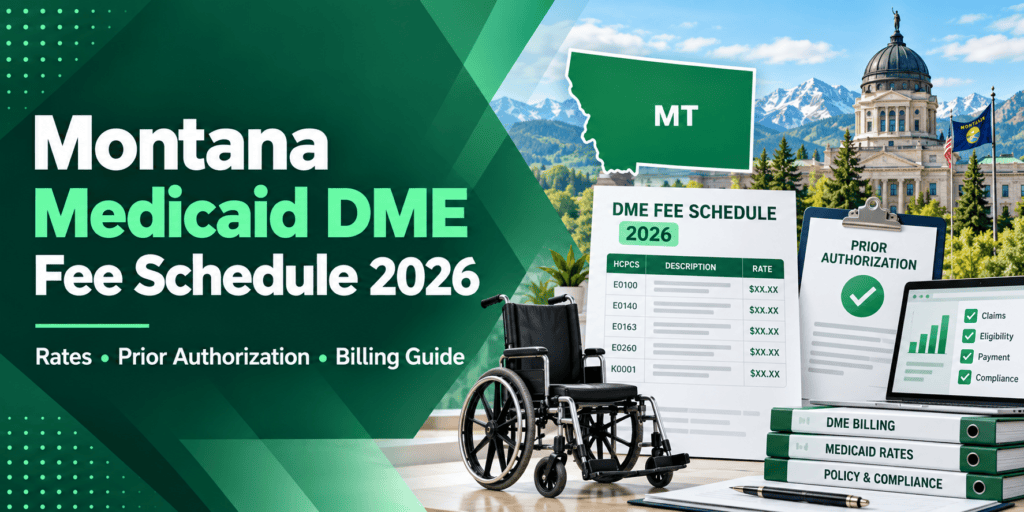
The Montana Medicaid DME Fee Schedule 2026 provides reimbursement rates for durable medical equipment, prosthetics, orthotics, and medical supplies. For DME and HME suppliers, finding the correct HCPCS code is only one part of the billing process. Payment can also depend on modifiers, prior authorization, medical necessity, pricing methodology, and whether the Medicaid member lives in a rural or non-rural area.
Montana published updated DME rates effective July 1, 2026. Providers should use the fee schedule that applies to the date of service and check the effective date listed for each code before submitting a claim.
Montana Medicaid DME Fee Schedule 2026: Complete Rates
The fee schedule includes HCPCS codes, equipment descriptions, applicable modifiers, pricing methods, rural and non-rural reimbursement amounts, and prior authorization indicators.
Montana Healthcare Programs
Durable medical equipment fee schedule
Montana pays a higher rate for many items delivered in rural areas, and most equipment is payable either as a purchase or a rental. Pick your region, then search any HCPCS code.
- July 1, 2026Effective
- 1,972Items listed
- 516Rentable
- 386Higher rural rate
- 336Need prior auth
No items match. Try the HCPCS code on its own, or clear the filters above.
How to read these ratesShowHide
Montana pays a higher rate for many items delivered in rural areas. Use the switch at the top to show the rate that applies to you; the other rate stays visible underneath for comparison.
Most durable equipment is listed twice in the source schedule, once for purchase and once with modifier RR for rental. They are shown together here. The rental rate is typically one tenth of the purchase rate.
MEDICARE means the rate follows the Medicare fee schedule. FEE SCHED is a Montana-set rate. MSRP means the item is priced from the manufacturer’s suggested retail price rather than a set fee, which is why those rows carry no dollar amount.
Y in the source schedule means prior authorization is required. Montana also requires PA whenever the reimbursement is $1,000.00 or more, or the MSRP is over $1,334.00, even where the PA column says N. Items that cross that threshold are flagged here.
The covered age range for the code. A maximum of 999 means there is no upper age limit.
The date the listed rate took effect. Many rates date from 1 January 2026; some are older and unchanged.
Source: Montana Healthcare Programs Fee Schedule, Durable Medical Equipment Services, effective July 1, 2026. Purchase and rental rows from the source schedule are shown together; rental rows carry modifier RR. Rates are for the fee-for-service delivery system. Confirm current rates and prior authorization requirements with Montana Healthcare Programs before billing.
HCPCS Code | Modifier | Description | Effective Date | Pricing Method | Non-Rural Rate | Rural Rate | Prior Authorization
When reviewing the table, pay close attention to the pricing method. Montana uses Medicaid-established fees, Medicare-prevailing rates, and manufacturer’s suggested retail price, or MSRP, calculations. Some HCPCS codes may appear more than once because different modifiers or billing situations can affect reimbursement.
How Montana Determines Rural and Non-Rural DME Rates
Montana has separate rural and non-rural reimbursement amounts for certain durable medical equipment.
For Medicare-prevailing fees, the applicable amount is based on the Medicaid member’s residential ZIP code rather than the DME supplier’s business location.
For example, a supplier located in Billings may provide equipment to a member who lives in a rural Montana community. In that situation, the billing team should determine which rate applies based on the member’s residence instead of automatically using the supplier’s location.
Not every HCPCS code has different rural and non-rural amounts. Providers should compare both columns before calculating expected reimbursement.
For suppliers that need help managing Montana-specific payer requirements, prior authorization, denials, and reimbursement issues, our Montana DME billing services are designed specifically for providers operating in the state.
Montana Medicaid DME Prior Authorization Requirements
Some durable medical equipment requires prior authorization before it can be supplied and billed. A Y in the fee schedule’s PA column indicates that the HCPCS code requires authorization. However, an N does not always mean approval is unnecessary.
Under Montana’s 2026 requirements, prior authorization may also be required when:
- The equipment reimbursement amount is $1,000 or more.
- The manufacturer’s suggested retail price exceeds $1,334.
These requirements can apply even when the HCPCS code itself shows N in the prior authorization column.
Before providing higher-cost equipment, suppliers should review the code, reimbursement amount, MSRP, quantity limits, and medical necessity requirements. A prior authorization request may require a prescription, clinical documentation, equipment specifications, supporting medical-necessity records, and applicable manufacturer pricing information. Authorization also does not automatically guarantee reimbursement. The final claim still has to meet Montana Medicaid’s coverage, documentation, and billing requirements.
MSRP-Based Reimbursement and Documentation
Not every DME item in Montana has a fixed reimbursement amount.
Some codes use MSRP-based pricing. These items require providers to review the applicable pricing methodology rather than relying only on a dollar amount shown in the fee schedule.
For applicable MSRP-priced equipment, Montana uses its established reimbursement methodology based on the provider’s usual and customary charge and supporting pricing information.
Documentation becomes especially important for miscellaneous, unlisted, and not-otherwise-classified equipment.
Supporting records should clearly identify:
- The manufacturer or supplying company
- Product name or description
- Product or model number
- Applicable HCPCS code
- Manufacturer pricing
- Document date
Pricing documentation should match the item billed and meet Montana’s current documentation requirements.
Incomplete, altered, unreadable, or unsupported pricing information can delay payment or lead to a denial.
Montana Medicaid DME Rental and Purchase Guidelines
Many DME claims involve rentals rather than outright purchases. Montana generally applies a 13-month rental reimbursement limit to equipment classified as capped rental, routine, or inexpensive equipment under applicable Medicare classifications.
Monthly rental reimbursement is generally limited in relation to the equipment’s purchase allowance, and total rental payments cannot exceed the applicable purchase amount. After the allowed continuous rental period is completed, ownership may transfer to the Medicaid member.
Suppliers should also keep the member’s previous rental history in mind. Changing DME suppliers does not necessarily restart the rental period, and a short interruption in use may not create a new rental cycle. Before billing a new rental, verify whether another provider previously supplied and billed for the same or similar equipment.
Maintenance, repairs, and servicing may also be included in the rental payment depending on the equipment category. Billing separately for services already included in the rental allowance can result in claim denials.
Important Billing Rules for Common DME Supplies
Incontinence Supplies
Montana issued additional billing guidance for incontinence products in 2026 following an increase in denied claims.
Providers should use the correct covered T codes for incontinence supplies.
Sterile and non-sterile gloves should be billed separately from T-code products when required.
Briefs, diapers, and pull-ups can also share quantity limits rather than each receiving a separate full monthly allowance.
This becomes particularly important when a member receives supplies from more than one provider. Combined quantities can exceed the Medicaid limit even when each individual supplier believes its own order is within the allowed amount.
If the member requires supplies above the standard quantity, prior authorization may be necessary.
Enteral Feeding Supplies
Enteral feeding codes such as B4034, B4035, and B4036 may include supplies needed for one day of enteral feeding.
Depending on the code, this may include items such as:
- Feeding bags
- Tubing
- Syringes
- Connectors
- Administration supplies
- Related dressings
Providers should avoid separately billing supplies that are already included in the daily enteral supply allowance. Using miscellaneous codes for items already bundled into another reimbursement amount can lead to denials or overpayment recovery.
Common Reasons Montana Medicaid DME Claims Are Denied
Having the correct HCPCS code and rate does not guarantee payment. Montana Medicaid DME claims can still be denied because of issues such as:
- Incorrect or missing modifiers
- Missing prior authorization
- Incomplete medical-necessity documentation
- Unsupported MSRP pricing
- Quantity limits being exceeded
- Incorrect rental history
- Items already included in another payment
- Incorrect dates of service
- Missing proof of delivery
- Coordination-of-benefits issues
- Incorrect member or payer information
DME billing teams should review the full claim before submission rather than relying only on the reimbursement table. Keeping the prescription, authorization, delivery record, manufacturer pricing, clinical documentation, and claim information together can also make denial follow-up easier.
Why the Published Fee May Differ From the Final Payment
The amount shown in the Montana Medicaid DME fee schedule is an important reimbursement reference, but it may not always equal the final payment.
The actual allowed amount can be affected by:
- Rural or non-rural classification: Some DME codes have different payment amounts depending on the Medicaid member’s residential ZIP code.
- Modifier used: Modifiers can change how a code is processed, especially for rentals, purchases, replacements, or other billing situations.
- Provider’s billed charge: Medicaid generally will not pay more than the amount the provider actually bills.
- Pricing methodology: Some items use fixed Medicaid rates, while others may be based on Medicare pricing or MSRP-related calculations.
- Medicare or other insurance payments: If another payer is primary, Medicaid may only cover the remaining eligible amount.
- Quantity limits: Payment can be reduced or denied when billed units exceed the allowed limit.
- Prior authorization: Claims may be denied or adjusted when required authorization was not obtained before the service.
- Medical necessity: The item must meet Montana Medicaid’s coverage and medical-necessity requirements.
- Rental history: Previous rental months can affect how much Medicaid pays and whether the item is still eligible for rental reimbursement.
- Documentation requirements: Missing prescriptions, proof of delivery, invoices, or supporting records can delay, reduce, or prevent payment.
When payment is lower than expected, compare the remittance advice with the correct fee schedule row before resubmitting or appealing the claim.
Frequently Asked Questions About Montana Medicaid DME Billing
What is the latest Montana Medicaid DME fee schedule for 2026?
Montana published an updated DME fee schedule effective July 1, 2026. Providers handling claims from earlier in the year should also check the applicable January 2026 schedule and the effective date associated with the individual HCPCS code.
Does Montana Medicaid use different DME rates for rural areas?
For certain Medicare-prevailing DME rates, Montana distinguishes between rural and non-rural reimbursement. The applicable rate is based on the Medicaid member’s residential ZIP code rather than simply the supplier’s office location.
Some HCPCS codes have the same amount in both categories, while others have different reimbursement levels.
Does an N in the prior authorization column mean PA is never required?
No.
The PA column should not be used as the only authorization check. Certain higher-cost equipment can require prior authorization based on its reimbursement amount or MSRP even when the schedule lists N.
Providers should check both the HCPCS-specific PA indicator and Montana’s additional authorization requirements before supplying expensive equipment.
Does Montana Medicaid reimburse all DME at Medicare rates?
No.
Montana uses different pricing methods depending on the code. Some items use Medicare-prevailing rates, while others have Medicaid-established fees or MSRP-based reimbursement.
Check the pricing method listed for the individual HCPCS code before estimating payment.
Why does an MSRP code not show a normal fixed fee?
MSRP-priced equipment may not have a standard fixed reimbursement amount because payment depends on the applicable pricing methodology and supporting manufacturer information.
Providers billing miscellaneous, unlisted, or specially priced equipment should make sure the required pricing documentation is available before submitting the claim.
How long can DME be rented under Montana Medicaid?
Certain equipment follows a capped rental structure that can extend up to 13 months. However, the exact rental rules depend on the equipment classification.
A supplier change or short interruption does not necessarily restart the rental period, so previous rental history should be checked before beginning a new billing cycle.
Can two Montana DME providers supply the same member with incontinence products?
A member may receive supplies from more than one provider, but the combined quantities still count toward applicable Medicaid limits.
If the total amount billed by multiple suppliers exceeds the allowed quantity, claims can be denied even when one supplier’s individual order appears reasonable.
Can Montana Medicaid pay secondary when a patient has Medicare?
For members who have both Medicare and Montana Medicaid, Medicare generally processes covered services first. Montana Medicaid may then consider the remaining eligible patient responsibility according to its crossover and reimbursement rules.
Providers should make sure coordination-of-benefits information is accurate before submitting or correcting secondary claims.
Why was my Montana Medicaid DME claim paid less than the fee schedule amount?
Possible reasons include the billed charge being lower than the published allowance, modifier differences, rural versus non-rural pricing, another payer’s payment, rental rules, quantity limits, or claim-specific reimbursement edits.
Review the remittance advice and compare the processed claim with the exact HCPCS and modifier combination listed in the applicable fee schedule.
What documentation should DME providers keep for Montana Medicaid claims?
Depending on the item, providers should maintain records such as:
- Physician orders or prescriptions
- Medical-necessity documentation
- Prior authorization information
- Signed proof of delivery
- Manufacturer invoices or pricing documents
- Rental history
- Equipment specifications
- Eligibility and insurance verification
The exact requirements depend on the equipment and billing situation.
How can DME suppliers reduce Montana Medicaid claim denials?
The best approach is to verify the member’s coverage, confirm the correct HCPCS code and modifier, check authorization requirements, review quantity or rental limits, collect supporting documentation, and verify the applicable reimbursement methodology before submitting the claim.
For providers that want support with these processes, DME Billing Service offers billing assistance for DME and HME suppliers, while our dedicated Montana DME billing services focus on state-specific billing requirements.
Need DME or HME Billing Services in Montana?
Montana Medicaid billing can become complicated when claims involve rural reimbursement, high-cost equipment, prior authorization, rental tracking, secondary insurance, or MSRP documentation.
DME Billing Service provides billing support for durable medical equipment and home medical equipment suppliers, including eligibility verification, claims submission, payment posting, accounts receivable follow-up, denial management, and billing support.
For providers specifically operating in Montana, visit our Montana DME billing services page to learn more about state-focused billing support.
Whether your business supplies wheelchairs, respiratory equipment, orthotics, enteral products, incontinence supplies, or other home medical equipment, accurate billing and consistent follow-up can help reduce preventable denials and improve reimbursement.