Washington Medicaid, commonly known as Apple Health, reimburses durable medical equipment and medical supplies through fee schedules published by the Washington State Health Care Authority (HCA).
For DME suppliers, checking the HCPCS code alone is not enough. The applicable payment can depend on the modifier, the member’s ZIP code, whether the item is purchased or rented, and whether prior authorization or expedited prior authorization is required.
As of October 2026, HCA lists the July 1, 2026 Medical Equipment and Supplies Fee Schedule as the current schedule. Earlier January and April versions remain relevant when researching claims with older dates of service. Washington State Health Care Authority
Washington HCA Medical Equipment and Supplies Fee Schedules
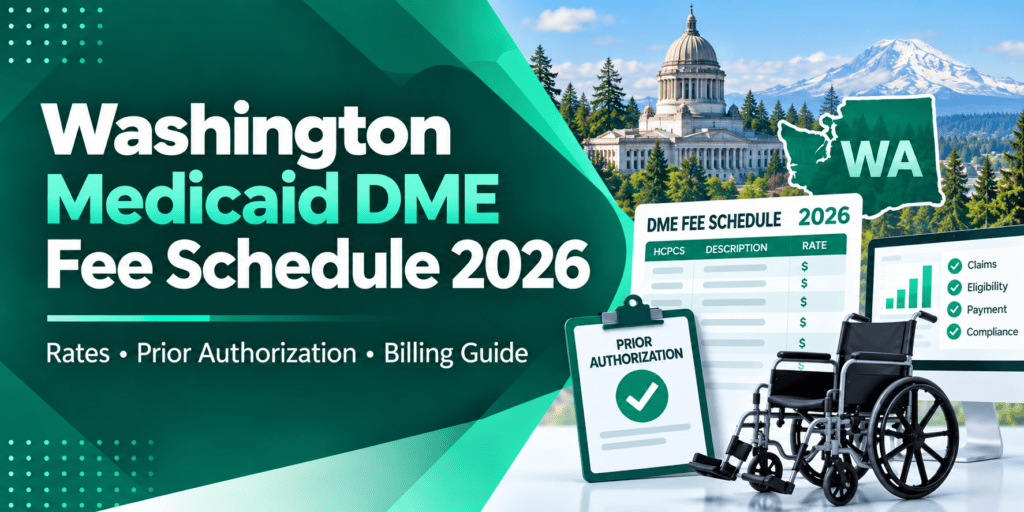
Washington Medicaid DME Fee Schedule 2026
Washington State Health Care Authority
Medical equipment & supplies fee schedule
Washington pays four different maximum fees for some codes, and the client’s ZIP code decides which one applies. Enter the ZIP and every rate below switches to the right column.
Client ZIP code — ZIP codes not on the HCA list are treated as non-rural
No codes match. Try the HCPCS code on its own, or clear the filters above.
How to read these ratesShowHide
The client’s ZIP code decides which column applies. ZIP codes that are not on the Health Care Authority list are treated as non-rural. Where the rural or competitive bid column reads N/A, the non-rural rate applies instead, so that is what this page shows.
Competitive Bid Area. Washington has two, around Seattle-Tacoma-Bellevue and around Vancouver, each with its own maximum allowable fee for some codes.
No set fee. An invoice or price list is required. Under the Health Care Authority’s by-report rule, billed charges of $1,100.00 or more need a detailed report attached to the claim; below that, do not attach one unless HCA asks.
The code is not paid on this schedule because an equivalent covered code exists. The comment names the code to use instead.
The service is managed through a different program, so it is billed under another billing guide rather than this fee schedule.
PA is prior authorization. EPA is expedited prior authorization, where the provider applies an authorization number themselves against published criteria instead of submitting a request.
NU is new purchased equipment, RR is equipment rental, RA is replacement equipment. A code listed with both NU and RR rows can be billed either way at the rate shown for each.
The source workbook carries values of L, R and L/R in this column but ships no legend for them, and its “Link to Legend” cell has no target. They are shown here exactly as published. Check the Medical Equipment and Supplies billing guide before relying on them.
Source: Washington State Health Care Authority, Medical Equipment and Supplies fee schedule, effective July 1, 2026, together with the ZIP code lookup table published in the same workbook. Column meanings follow the HCA Medical Equipment and Supplies billing guide. The source schedule carries no code descriptions, so codes are searchable by number, modifier and comment. Rates are maximum allowable fees for fee-for-service and may differ from managed care plan rates. Confirm current rates with HCA before billing.
The July 2026 HCA schedule includes the information DME billers need to compare reimbursement correctly:
Do not combine multiple rows for the same HCPCS code. WA medicaid dme fee schedule may list separate entries for purchase, rental, authorization status, or other billing conditions. Keeping each code-and-modifier combination separate makes the table much more useful for claim preparation.
Which 2026 Washington Medicaid Fee Schedule Should You Use?
Washington published three Medical Equipment and Supplies schedules during 2026:
- January 1 through March 31, 2026
- April 1 through June 30, 2026
- July 1, 2026 to present
Use the schedule that corresponds with the date of service, not simply the date the claim is being submitted. This is especially important when correcting older claims or reviewing an underpayment months after the equipment was delivered.
For current claims, the July 1, 2026 schedule should normally be the starting point.
How to Read the Washington DME Fee Schedule
Several abbreviations in the schedule affect how a claim should be handled. The Code Status Indicator may show:
| Indicator | Meaning |
|---|---|
| D | Discontinued code |
| L | Limitations apply |
| N | New code |
| P | Policy change |
| R | Rate update |
The rate and comment fields also use several important abbreviations:
| Abbreviation | Meaning |
| BR | By Report |
| CBA | Competitive Bid Area |
| DC | Not covered under this code; use the indicated different code |
| DP | Covered under another program |
| EPA | Expedited Prior Authorization |
| NC | Not covered |
| NU | Purchased new equipment |
| PA | Prior Authorization |
| RA | Replacement of a DME item |
| RR | Rental |
These indicators should remain visible in your online rate table. A blank dollar amount or a BR, DP, or DC entry can have a very different meaning from a noncovered item.
Washington Rural, Non-Rural, and CBA DME Rates
One of the biggest differences between Washington and many other state Medicaid programs is geographic pricing. The July 2026 schedule can show separate rates for:
Non-Rural | Rural | Seattle CBA | Vancouver CBA
For applicable items, the correct amount is determined using the Apple Health member’s ZIP code. The ZIP lookup included with the HCA schedule classifies applicable areas as rural or as part of a Competitive Bid Area. ZIP codes that are not identified in the lookup are treated as non-rural.
This means a DME supplier should not use its own office or warehouse ZIP code when determining the applicable payment category. For example, a supplier located in Seattle may provide equipment to a member living in a rural Washington ZIP code. When geographic pricing applies, the member’s location determines which fee column should be reviewed.
Washington’s reimbursement regulations also state that certain equipment subject to federal payment limitations is priced using the lower applicable Medicare DMEPOS or Competitive Bid Area amount. Washington State Legislature
What if the Seattle or Vancouver CBA rate says N/A?
The July 2026 HCA schedule provides a useful rule: when the CBA rate column displays N/A, providers should use the Maximum Allowable Non-Rural Rate. That distinction should be explained near your rate table because N/A should not automatically be interpreted as “not covered.”
NU, RR, and RA Modifiers Matter
Always check the modifier before using a reimbursement amount. NU identifies purchased new equipment, while RR identifies rental equipment. RA is used for replacement of a DME item when applicable. The same HCPCS code may therefore appear more than once with different reimbursement amounts.
For example, an equipment code may have one NU row showing the purchase allowance and a separate RR row showing the rental payment. Using the purchase amount to estimate a rental claim or vice versa can produce an incorrect expected reimbursement.
Washington also purchases new equipment, so the NU designation is particularly important when reviewing purchase claims.
Prior Authorization in Washington Medicaid DME Billing
Some equipment must receive HCA approval before it is delivered.
Washington requires prior authorization for designated medical equipment and services. The applicable PA request generally needs supporting information such as the manufacturer, equipment model, description, requested modifications, and patient-specific medical justification. Washington State Legislature
The prescribing documentation used for a PA request must also meet Washington’s timing requirements. HCA states that when it receives an initial authorization request, the prescription cannot be more than six months old.
A general statement such as “patient needs a wheelchair” may not be enough for more complex equipment. Washington requires justification for the base equipment and separately charged accessories or modifications.
Washington DME Prior Authorization Rule — WAC 182-543-7100
PA and EPA Are Not the Same
Washington also uses Expedited Prior Authorization (EPA) for selected equipment and supplies. EPA is designed to avoid the normal written or telephone PA process when the patient meets defined criteria. The supplier follows HCA’s published criteria, creates the required authorization number, and reports that number on the claim.
Providers must still keep documentation showing that the member met the EPA conditions. HCA can request those records later. If the member does not meet the EPA criteria, the service is not automatically excluded. A standard prior authorization request may instead be required.
Washington Expedited Prior Authorization Rule — WAC 182-543-7300
“PA – Exceptions to Max or Age” Needs Special Attention
Some rows in the 2026 fee schedule use an authorization note such as PA – Exceptions to Max or Age. This usually means the standard amount, frequency, duration, or age restriction can be billed without PA when the normal criteria are met, but going beyond that limit requires authorization.
Washington specifically requires providers to request PA when they need to exceed established quantity or frequency limits for equipment or supplies that otherwise do not routinely require approval. This is especially important for recurring medical supplies. A covered HCPCS code does not mean unlimited units are payable.
When the member’s medical needs cannot be met within a program limit, HCA also provides a Limitation Extension (LE) process. Washington State Health Care Authority
What Does BR Mean on the Washington Medicaid DME Schedule?
BR means By Report. A BR entry does not mean the item has a $0 reimbursement rate. It means there is no standard fixed dollar amount in the fee schedule, and HCA calculates payment using its By Report methodology.
Washington evaluates BR items based on medical necessity, appropriateness, and reimbursement value. Current rules require the supporting MSRP or invoice to be dated within 12 months before the date of service and to support the specific item being billed. Washington State Legislature
The reimbursement calculation depends on the equipment category.
| BR Item Category | Reimbursement Method |
| Basic standard wheelchairs | 65% of MSRP or 140% of acquisition cost |
| Wheelchair parts and add-on CRT accessories | 84% of MSRP or 140% of acquisition cost |
| Certain wheelchair cushions, CRT manual bases, modifications and seating systems | 80% of MSRP or 140% of acquisition cost |
| CRT power-drive wheelchair base | 85% of MSRP or 140% of acquisition cost |
| Prosthetics, orthotics and related medical supplies/services | 85% of MSRP or 125% of acquisition cost |
| Other medical equipment | 80% of MSRP or 125% of acquisition cost |
| Medical supplies | 85% of MSRP or 125% of acquisition cost |
These percentages are established in Washington’s Medicaid reimbursement rule. When billing a BR item, make sure the invoice or manufacturer pricing actually matches the product supplied. An outdated invoice or documentation for a different model can affect reimbursement.
Washington Medicaid DME Reimbursement Rule — WAC 182-543-9000
Why the Fee Schedule Amount May Not Match the Final Payment
The listed figure is a maximum allowable amount, not a guarantee that every correctly submitted claim will pay exactly that amount. Washington limits payment to the lower of:
- The provider’s usual and customary charge, or
- The established Medicaid rate.
Apple Health is also the payer of last resort when the member has Medicare or another liable insurer.
Several costs are already included in the reimbursement for covered purchased or rented equipment, including delivery, shipping and handling, fitting, setup, routine maintenance, and instruction on using the equipment. These should not automatically be added as separate charges.
When payment is lower than expected, compare the remittance advice against the exact HCPCS code, modifier, geographic rate, billed charge, authorization status, and other insurance payments before correcting the claim.
Proof of Delivery and Date of Service
A correctly priced claim can still fail if delivery documentation is incomplete. Washington requires the item to be delivered before the provider bills Apple Health. When the supplier directly delivers the equipment, the actual delivery date is used as the date of service.
Items that require fitting cannot simply be sent through a standard delivery or shipping service under Washington’s proof-of-delivery rules. Washington State Legislature
For DME suppliers, keeping the prescription, authorization, product details, proof of delivery, and claim information together makes later denial or audit review much easier.
Apple Health Fee-for-Service vs. Managed Care
The HCA fee schedule is especially important for Apple Health fee-for-service claims. A member enrolled in an Apple Health managed care organization may be subject to the plan’s own authorization, network, coverage, and reimbursement requirements.
HCA directs providers to contact the member’s managed care plan directly for program benefits when the member is enrolled with organizations such as Community Health Plan of Washington, Coordinated Care, Molina Healthcare of Washington, UnitedHealthcare Community Plan of Washington, or Wellpoint Washington. Washington State Health Care Authority
So, do not assume the FFS fee shown in the state schedule is automatically the contracted payment for every Medicaid managed care claim.
A Missing Code May Be Covered Under Another Washington Program
Not every DME-related item is priced in the Medical Equipment and Supplies schedule. Washington publishes separate fee schedules or billing guidance for specialized services such as complex rehabilitation technology and other benefit categories. A DP entry in the Medical Equipment and Supplies table specifically means the service is covered under another program, and the comments should be checked for direction.
Before treating a missing code as noncovered, review the appropriate HCA program and current billing guide.
Washington HCA Provider Billing Guides and Fee Schedules
Common Washington Medicaid DME Billing Errors
The most common problems are not usually caused by the fee itself. They happen when the wrong rate or billing rule is applied. Watch for the wrong NU or RR modifier, using the wrong ZIP-based rate, missing PA or EPA, exceeding quantity limits without approval, treating BR as a zero-dollar fee, billing before delivery, or applying the Apple Health FFS schedule to a managed care claim.
Duplicate equipment is another risk. Washington generally does not reimburse equipment that duplicates an item the member already owns, rents, or has authorized unless the provider can justify why the existing equipment no longer meets the member’s needs or cannot be repaired or modified. Washington State Legislature
A good billing review should therefore answer more than “What is the HCPCS rate?” It should confirm which rate applies to this exact member and claim.
Frequently Asked Questions
What is the current Washington Medicaid DME fee schedule for 2026?
The current Medical Equipment and Supplies schedule is effective July 1, 2026. Washington also maintains January and April 2026 schedules for earlier service dates. Washington State Health Care Authority
Is Washington Medicaid the same as Apple Health?
Yes. Apple Health is Washington State’s Medicaid program, administered by the Washington State Health Care Authority.
Does the patient’s ZIP code affect Washington Medicaid DME reimbursement?
For applicable equipment, yes. Washington’s 2026 schedule separates non-rural, rural, Seattle CBA, and Vancouver CBA rates. The member’s ZIP code is used to determine the applicable geographic category.
What happens when the CBA rate is listed as N/A?
The July 2026 schedule instructs providers to use the maximum allowable non-rural rate when the applicable CBA rate column shows N/A.
Does BR mean the item is not covered?
No. BR means By Report. HCA determines payment using supporting pricing information and the reimbursement methodology established for that equipment or supply category. Washington State Legislature
What is the difference between PA and EPA?
PA uses Washington’s standard prior authorization process. EPA is an expedited process for selected codes where the supplier applies established criteria and creates an authorization number. If EPA criteria are not met, standard PA may be required. Washington State Legislature
Can a code require authorization even when regular PA is not listed?
Yes. Quantity, frequency, age, or duration limits can trigger an authorization requirement when a provider needs to exceed the normal allowance. Washington State Legislature
Does the published fee guarantee reimbursement?
No. The fee is a maximum allowable amount. Final reimbursement can depend on the provider’s billed charge, authorization, modifier, geographic category, other insurance, documentation, and claim-specific processing rules. Washington State Legislature
Need Help With Washington DME and HME Billing?
Washington Medicaid claims can become difficult when reimbursement depends on ZIP-based rates, purchase and rental modifiers, EPA criteria, By Report pricing, supply limits, or coordination with Medicare and managed care organizations.
DME Billing Service helps DME and HME suppliers manage eligibility verification, payer requirements, coding and modifiers, claim submission, payment posting, accounts receivable, denials, and appeals. The goal is to catch billing problems before they turn into delayed or unpaid claims.
If your company supplies equipment across multiple states, licensing requirements can also change depending on the products being dispensed. Our DME licensing requirements by state guide includes Washington and explains when product categories such as pharmaceuticals or regulated items may trigger additional licensing considerations.
For Washington DME providers, the safest approach is simple: find the exact HCPCS and modifier, confirm the member’s ZIP category, check PA/EPA and limits, verify documentation, and then compare the claim with the applicable 2026 rate.